
Canada has more lakes than any other country in the world, along with thousands of kilometres of navigable rivers and an extensive Pacific, Atlantic, and Arctic coastline. Recreational boating takes place across an enormous range of conditions — a flat-water lake in Northern Ontario behaves very differently from a tidal channel off Vancouver Island or the chop of Lake Erie on a windy afternoon. The vessel you choose should match not just your intended activity, but the specific water body where you plan to spend most of your time.
Motorboats and Powerboats
Motorized recreational boats remain the most widely used category in Canada. They range from small aluminum fishing boats with modest outboards to large fibreglass runabouts and cabin cruisers. The key regulatory consideration is that anyone operating a motorized pleasure craft in Canadian waters must carry a valid Pleasure Craft Operator Card (PCOC), regardless of the vessel's size.
Aluminum Fishing Boats
A 14- to 17-foot aluminum hull with a 15–30 HP outboard is the workhorse of Canadian freshwater fishing. Lightweight, durable, and resistant to the abrasion that comes with rocky lake bottoms, these boats are straightforward to trailer and easy to launch from gravel ramps. They perform well in calm conditions but are not well suited to open Great Lakes water or exposed coastal zones where wave height can build quickly.
Fibreglass Runabouts
A step up in size (17–24 feet) and comfort, fibreglass runabouts handle moderate wave action better than small aluminum boats. They typically carry higher-horsepower outboards or stern drives and are used for water sports, day cruising, and fishing. Fuel consumption is a practical consideration on longer trips, particularly given that marinas are spaced unevenly on larger northern lakes.
Cabin Cruisers
Cabin cruisers (roughly 24–40 feet) provide overnight accommodation and are used for extended trips on the Great Lakes, the Rideau Canal, and coastal British Columbia. At this size, vessel registration under the Canada Shipping Act typically becomes mandatory, and operators benefit considerably from formal navigation training.

Sailboats
Sail-powered vessels occupy a different regulatory space from motorized craft. A vessel powered exclusively by sail does not require the operator to hold a PCOC, although Safety equipment requirements still apply in full. Competency certifications from Sail Canada are widely recognized and strongly recommended for anyone planning to sail on open water or in tidal areas.
Dinghies and Day Sailors
Dinghies — small, open, single-hull boats in the 8–16 foot range — are the standard starting point for learning to sail. They are responsive and sensitive to weight distribution, which makes them excellent teaching platforms. Popular dinghies used in Canadian sailing programs include the Laser, the 420, and the Optimist for younger sailors. Most community sailing clubs across Canada use a mixed dinghy fleet for instruction.
Keelboats
A keelboat carries a fixed ballast keel that provides stability and resists capsizing. This makes it more forgiving in rough water and more suitable for longer distances. Lake Ontario and Georgian Bay in particular have a large keelboat cruising community. Keelboats in the 27–36 foot range represent the most common cruising size for Canadian inland and coastal sailing.
Pontoon Boats
Pontoon boats are flat-deck platforms supported by two or three cylindrical floats. They offer exceptional stability and deck space, making them popular for families and social outings on calmer water. Most pontoons are powered by outboard motors and fall under standard motorized vessel regulations. Their flat hull profile means they are best suited to protected lakes and rivers; they handle poorly in waves above one metre.
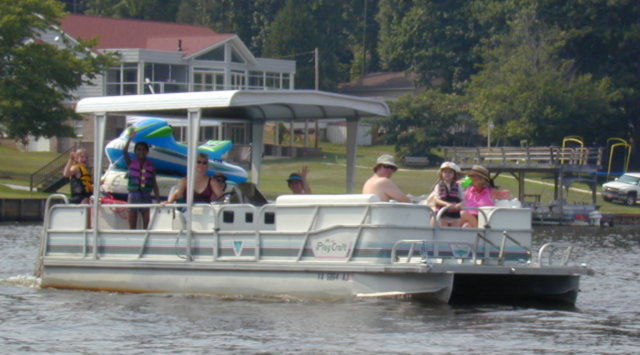
Human-Powered Vessels: Canoes and Kayaks
Canoes and kayaks hold a particular cultural importance in Canada and remain extremely popular for both casual paddling and multi-day wilderness trips. Under the Canada Shipping Act, human-powered vessels are still subject to safety equipment requirements: a buoyancy aid or PFD for each person on board is mandatory, as is a sound signalling device and, when paddling after dark, a white light.
Canoes
Open canoes (15–18 feet) are versatile and can carry substantial gear loads. The typical recreational canoe hull is made from fibreglass, Kevlar, or polyethylene. Solo canoes (12–15 feet) are narrower and more responsive. In rivers with moving current, paddlers should have a minimum understanding of reading water and ferry angles before attempting anything beyond grade I.
Sea Kayaks
Sea kayaks (16–18 feet for singles, 18–22 for tandems) are designed for open-water conditions. They track well and handle wave action that would overwhelm a recreational kayak. Paddling a sea kayak in tidal waters or on a large lake requires knowledge of weather patterns, rescue techniques, and navigation. The Paddling Canada certification program provides a structured progression for skill development.
Matching Vessel to Water Type
The clearest way to think about vessel selection for Canadian waters is to start with the body of water, not the boat. Sheltered cottage lakes under 10 square kilometres suit almost any category of recreational vessel. Large exposed lakes like Huron, Superior, or Winnipeg demand more freeboard, more reserve buoyancy, and more reliable power than small lakes require. Tidal waters on the Pacific and Atlantic coasts add a third layer of complexity — currents, tide tables, and local hazards that are specific to each channel or inlet.
Transport Canada maintains a public database of safety advisories and water body hazards that is worth consulting before taking an unfamiliar vessel onto unfamiliar water.
Registration and Licensing Requirements
Any pleasure craft equipped with a motor of 10 HP (7.5 kW) or greater that operates in Canadian waters must have either a Pleasure Craft Licence (PCL) or be registered under Part 2 of the Canada Shipping Act, 2001. The PCL is free and issued online through Transport Canada. Registration is required if the vessel is used as security for a marine mortgage, operated outside Canada, or if the owner chooses formal registration for other reasons. Both the PCL number and the PCOC must be carried aboard and available for inspection.